


Swift School in Roswell, Georgia is helping students learn and grow in new ways through a daring inclusive playground! Specially designed by occupational therapist Stephanie Young and Playworld representative Playworld Preferred, the space furthers Swift School’s mission of empowering students with dyslexia and other language-based learning differences.
“[Stephanie] could actually walk through the playground in her mind as she was creating this to see what it would help the children do,” said Kim Breedlove, sales representative at Playworld Preferred. “It was very inspirational watching her design this and something that I had quite never seen before.”
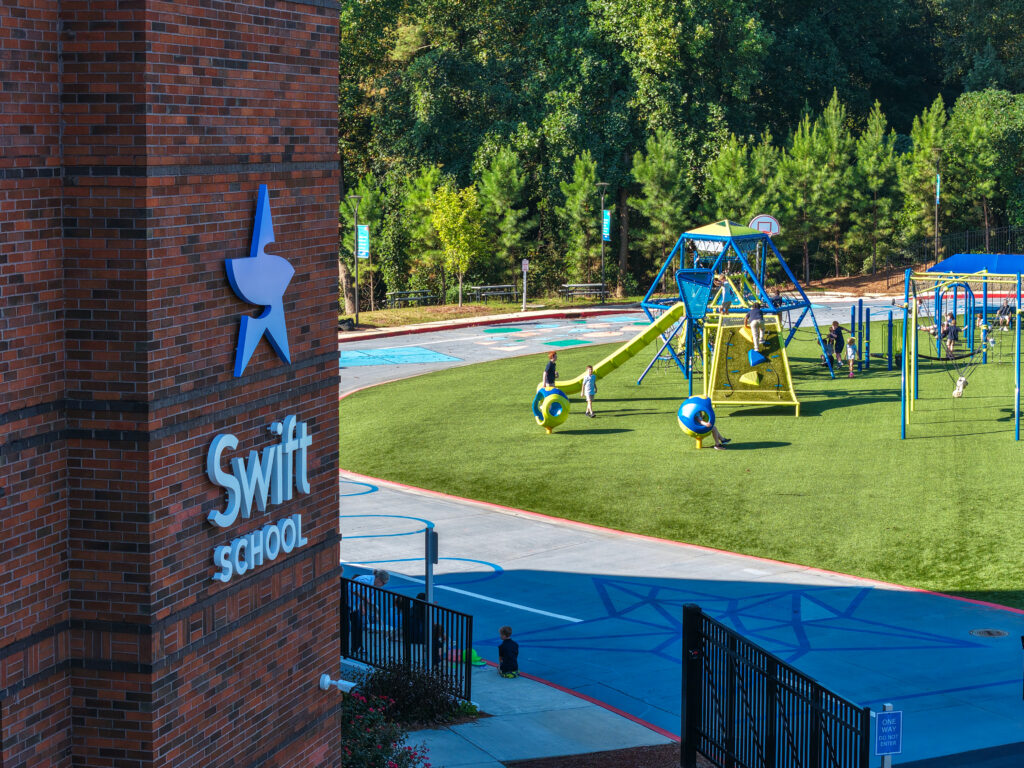
Young used Playworld’s System of Play to create an interconnected layout that maximizes the benefits for Swift students. Kids can climb PlayHills® to reach RopeScapes® products Base Camp, Quito®, and Tianzi®, or enjoy sliding down the Dynamic Descent. Mighty Descent is also connected to Quito, while two Cozy Cocoons and a series of swings are located nearby.
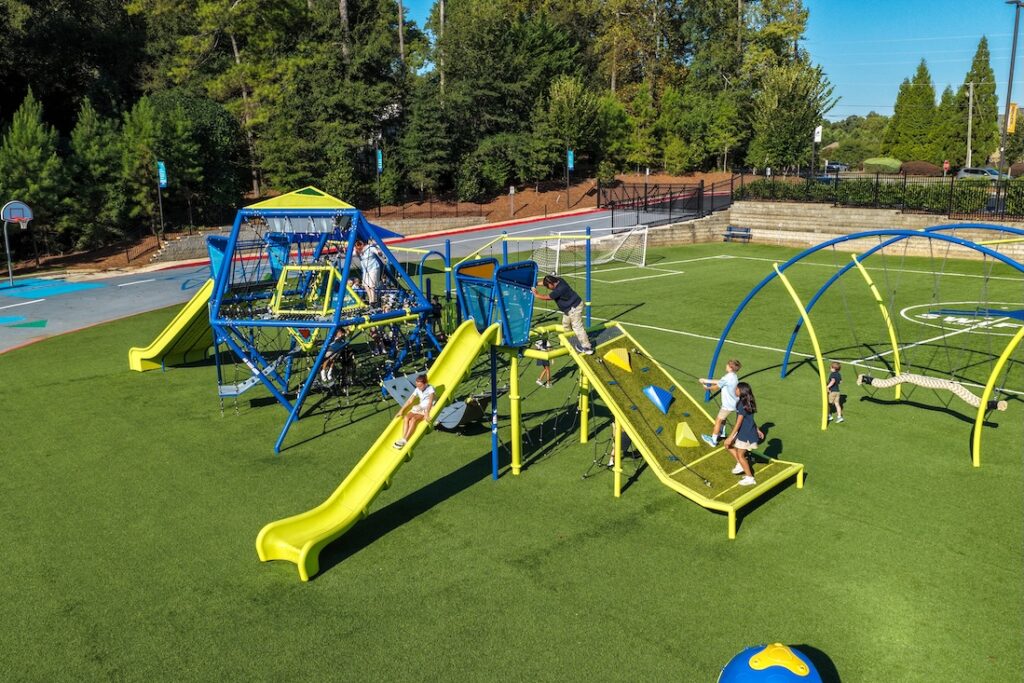
“My role as an occupational therapist is to prep the kids for the activity that they’re about to go into in the building,” said Young. “I chose Playworld specifically because I really liked the ability that I had as a consumer to pick different modular pieces and make the whole playground design customized to the individual learning systems that they have inside the Swift School.”
Young views the play space as “an outdoor occupational therapy clinic,” noting how it provides linear motion and rotary input for vestibular systems, proprioceptive climbing, tactile input, and gross motor activities. In addition to the variety of play opportunities, Young also chose the equipment for its strategic design; the angle of PlayHills helps ease tight nervous systems and anxiety by facilitating heel-cord extension and encouraging kids to stretch and crawl. The open play paths of Quito also develop creative problem solving skills and reading comprehension by helping students visualize what it means to move over, under, through, and next to something.
In addition to Young’s curriculum, the play space is used throughout the school day by teachers and faculty members.
“We love the fact that a teacher can say, ‘You know what, let’s take a 10-minute brain break. Let’s go out to the playground,” said Chris Pomar, Head of Swift School. “So they’ll come out here and run and jump and play and spin and climb for 10 minutes…and whatever [the students] were doing before they came out here, their brain process is improved by the time they come back in the room.”
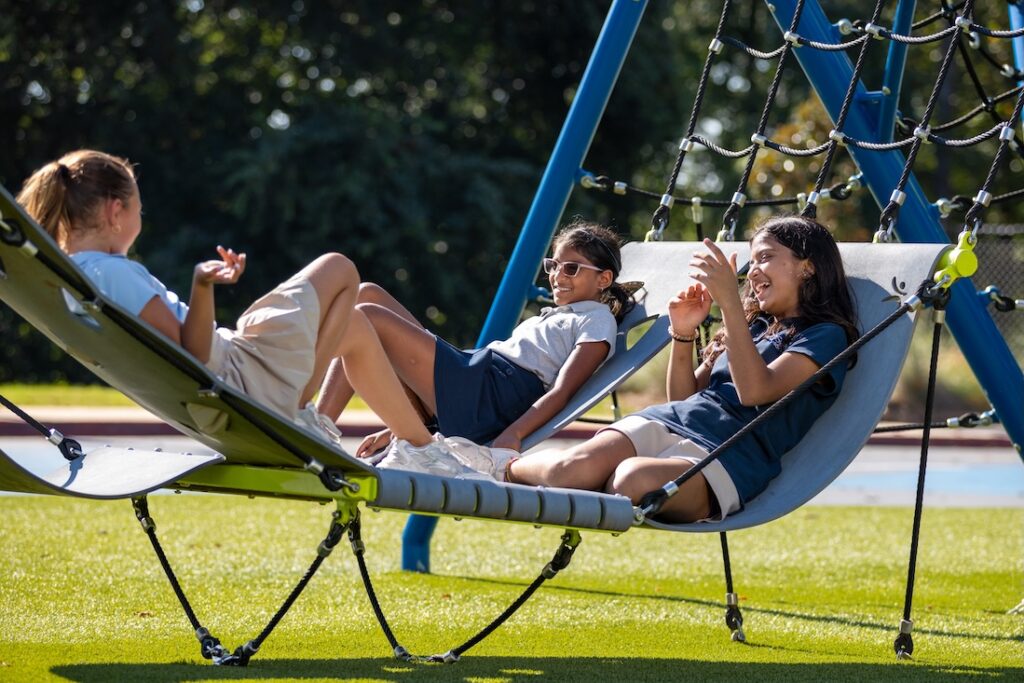
The impact of time spent on the playground can also be felt beyond the classroom. During the school’s “Screen on the Green” and other community events, students can be seen guiding their families through the play space with pride and modeling positive play for their peers. They also exhibit more confidence and capability when visiting other playgrounds in the area, and are able to showcase their strengths in ways they weren’t able to before.
“This playground is transformational,” said Melissa Baccala, Dean of Admission and Academic Programs, “because it takes a student or a child from a very fragile, maybe nervous state, and it builds confidence and it builds grit and growth and stamina—and it’s just plain fun!”
Want to create a play space designed around how your students learn? Meet with a Playworld representative.
